A Trade War supported by Lies
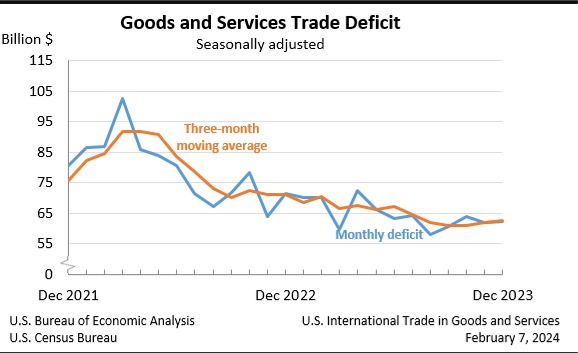
Trump claimed that in 2024, “China made $1 trillion off trade with the United States.” Donald Trump, April 11, 2025. Trump made this claim 5 times in the last week. It is false. There is a trade imbalance with China. China surplus is 263 billion dollars. It means that China sells a lot more goods and services to the US than we sell to China. This surplus was decreasing in 2023 and 2024.
Economists have warned Trump that trade wars are a lose-lose game. The cost of tariffs are passed on to consumer, increasing the cost of products. In 2024, candidate Trump acted concerned about inflation. He blasted Biden for high inflation which peaked in 2022. He gave Biden no credit for bringing down inflation. Now, he doesn’t care. See article:
Commentary: Trump never cared about inflation
It is an excellent article. The tariffs cause stagflation, which is a combination of increasing prices and a slowing economy. His reaction is a quick fix, by lowering interest rates, which makes borrowing easier. He is now looking ways to fire Jerome Powell, Chair of the Federal Reserve, so he can install someone who will cut interest rates. The Federal Reserve is an independent branch of government.
Another lie is how much the US is gaining on the payment of tariffs. The U.S. is “taking in almost $2 billion a day in tariffs.” according to Trump. It’s way off base. Politifact rules this as false. The U.S. Treasury’s April 8 daily statement shows $192 million in revenues for custom duties and certain excise taxes.
Politifact link on tariff payments
More absurd false statements came from Karoline Leavitt, Trump’s Press Secretary, who stated that the tariffs should be viewed as a tax cut. Politifact judges this as false. See link below. I particularly like the quote from economist Tara Sinclair, who stated “Economists don’t agree on much, but we agree tariffs are taxes on consumers.” Yes, Trump is raising taxes. If you read Leavitt’s response to a journalist, you have to give her an A+ for creativity in presenting a rosy outlook, detached from present reality.
Politifact link on tariffs as tax cuts
Liberation Day (April 2) and Hitting the Pause Button (April 9)
April 2 was called Liberation Day by Trump as the trade war suddenly impacted approximately 150 countries with tariffs as high as 50%. Trump referred to them as “reciprocal tariffs” but they were not based on tariffs the countries imposed on US goods sold in their countries.
The reaction was immediate. Across April 3 and 4, U.S. stocks lost $6.6 trillion in value, their largest two-day loss in history by a margin of $2.2 trillion. On April 9, Trump paused all new tariffs for 90 days.
The situation since April 9 is very fluid. The reactions of world leaders were not like Trump described it, as leaders desperately trying to make deals with the US in a mad rush to avoid these tariffs. Instead, they consulted with their other trading partners. It is likely the multinational talks will continue. See Wikipedia link at end.
China and Japan’s Reactions
An extremely high tariff of 125% is currently levied against all of China’s exports. China responded with a tariff of 145% against US goods.
For his part, Chinese President Xi Jinping travelled to three Southeast Asian countries last week to bolster regional ties. He called on trading partners, including Vietnam, to oppose unilateral bullying. “There are no winners in trade wars and tariff wars,” Xi said in an article published in Vietnamese media, without mentioning the US.
Trump stated there has been great progress with Japan on tariffs. Japan’s response to tariffs on export of cars, was that it was “inconsistent” with the trade agreement of 2019 as negotiated in Trump’s first term. So, Trump agreed in 2019 not to levy tariffs on cars, then once he’s re-elected, he ignores his own trade agreement. See link below.
Trump’s auto tariffs spark concerns in Japan
A credibility gap has gotten larger. Trump and his economic advisors, continue their rosy outlook, while the trade relationships deteriorate coupled with a slowing economy and higher prices. The Dow Jones Average dropped about 1,000 points as investors looked elsewhere to invest their money.
How far will Trump go?
Trump is in trouble. Ir is not just his wealthy donors are losing money in the stock market. Many Americans are feeling the pain. My retirement account has definitely been hit hard. Tariffs will mean higher prices. Economists have shown it is the poorest Americans, who buy the most goods affected by tariffs.
“President Donald Trump has proven that tariffs work for the American people,” Mr. Navarro said in January. “It’s not going to be painful for America. It’s going to be a beautiful thing.”
Peter Navarro is the senior counselor for trade and manufacturing to U.S. president Donald Trump since January 2025. Mr. Navarro echoed Mr. Trump’s false claims that he won the 2020 election. And he defied the Congressional subpoena relating to the Jan. 6 riots at the Capitol, and was sentenced to jail. Upon his release, Mr. Navarro went directly to the campaign trail and campaigned for the president through Election Day.
So, how far will Trump go all depends on who has Trump’s ear at the time. It has been reported that his other economic advisors want to have a more focused approach to tariffs. But, Trump doesn’t back down easily, despite the push back.
The Wikipedia link provided below is an excellent review of the current tariffs and generally be kept up to date.
Stay tuned,
Dave
Wikipedia: Tariffs in the second Trump administration
NY Times, April 20, The Trade Adviser Who Hates Trade
I have included this link, but I am not sure if it can be opened by non-subscribers to NY Times. It is an excellent article on Peter Navarro.
 news and views