Trump’s Canada Bashing and Lies to Justify Tariffs

Wow! In Trump’s first term, Trump would miss no opportunity to brag about the USMCA (US, Mexico and Canada) that is a trade agreement he negotiated to replace NAFTA. He campaigned relentlessly on the idea that both Mexico and Canada were taking advantage of NAFTA, and he was able to negotiate a lot better agreement.

As usual, in his first term, Trump said: I’m going to renegotiate NAFTA, one of the worst trade deals ever signed in the history of our country.

This could be because it was signed by a Democrat, Bill Clinton. Trade agreements are very long documents covering many issues. From Wikipedia:

During his 2016 election campaign and presidency, Trump was highly critical of NAFTA (often times describing it as “perhaps the worst trade deal ever made”) while extolling USMCA as “a terrific deal for all of us”. The USMCA is very similar to NAFTA, carrying over many of the same provisions and making only modest, mostly cosmetic changes, and is expected to have only a minor economic effect. Former U.S. Trade Representative Mickey Kantor, who oversaw the signing of NAFTA during the Bill Clinton administration, said, “It’s the original NAFTA.”

The last comment by Mickey Kantor is likely a bit exaggerated, as there were significant changes in the USMCA agreement as discussed in the Wikipedia post.

Trump’s Lies

So far I count 12 lies. More are probably coming. Historically, the US and Canada have been very good partners, working out our differences without a lot of political rhetoric and lies. All these lies were told by Trump since January 2025. Some lies are directed at President Biden as usual (lie # 4 and 12). Remember they are lies.

1 FALSE: Canadian public likes the idea of becoming the 51st state. Truth is the Canadian public overwhelmingly opposes.

2 FALSE: US trade deficit with Canada is $200 billion. Trump has also stated the deficit is around $250 billion (from Barron’s). Barron’s cites our deficit with Canada is $64 billion. CNN cites two deficit values, 36 billion and 71 billion, the lower figure is for goods and services, and the higher value is for goods alone. All these values are nowhere close to the values cited by Trump.

3 FALSE: Canada is one of the world’s highest-tariff countries. It is actually low in global rankings.

4 FALSE: Canada hiked its dairy tariffs during the Biden administration. Tariffs haven’t changed since Trump’s first presidency.

5 FALSE: President Donald Trump claims that Canada has been “ripping us off for years” with a 250% tariff on U.S. dairy products. (Yahoo Finance) . “It is accurate that Canada imposes a tariff of approximately 250% on U.S. exports of certain dairy products into Canada. However, that tariff would only apply if we were able to reach and exceed the quota on U.S. dairy exports agreed to under the U.S.-Mexico-Canada Agreement.” (Yahoo Finance- Link provided below). This is the trade agreement that Trump boasted as a “terrific deal for all of us.”

6 FALSE: Canada generally doesn’t “take” US agricultural exports. Canada is the world’s second-biggest buyer of those exports.

7 FALSE: Canada prohibits US banks. Truth is that more than a dozen US banks are operating in Canada today. Barrons and CNN consider this is a lie. “American banks are not allowed to do business in Canada,” Trump said in a social media post last month.

8 FALSE: Canada is “constantly surrounded” by Chinese and Russian ships. In fact, a smattering of Russian and Chinese military ships and jets, as well as Chinese research vessels viewed with suspicion by Canada and the US, have been occasionally spotted in recent years in the vicinity of the US state of Alaska – and have been monitored or intercepted by the Canadian and US militaries.

9 FALSE: Outgoing Prime Minister Justin Trudeau was using the ongoing tariff battle to run again for prime minister. The truth is Trudeau clearly wasn’t running.

10 FALSE: Canada spends less than 1% of gross domestic product on defense. Truth is NATO figures showed it was an estimated 1.37% last year.

11 FALSE: Trump has claimed that Canada gets 95 percent of its “product” from the United States. Trump is talking about foreign imports. US accounts for 62%. About 76% of goods exported from Canada go to the US.

12 FALSE: Trump claims massive entry of illegal immigrants and vast quantities of fentanyl from Canada. He does this by lumping Mexico and Canada together as if together, they are causing unemployment, crime and drug addiction. So, while this has nothing directly tied to tariffs, I guess the point Trump is making is that we have to start hating Canada and problems they caused, to justify the tariffs.

But consider the absurdity of it all, when we levy tariffs against a country, which has very little to do with our fentanyl epidemic or illegal immigration. Exactly, how do Canadian leaders roll back tariffs?

I guess for those who hate foreigners and blame all problems on them, this lie works. As researched by Factcheck.org, the two countries are very different. For example, in December 2024, apprehensions from Canada was 510 illegals, as compared to with 47,326 illegals from Mexico. So the split between the two countries is 99:1.

This lie about Canadians bringing in vast quantities of fentanyl is closely tied to another lie from Trump, that the fentanyl addictions accounted for 300,000 deaths in the US in 2024. Usually, this lie is tied to a political statement that Biden and the liberals did nothing about the illegal drug trafficking.

So, there is a long series of lies to correct. And I have to back up a bit. First, fentanyl is the narcotic of choice for drug smugglers because it is so concentrated, that a very small amount can cause an overdone. It is well documented that fentanyl is not carried over our border with Mexico by illegal immigrants. It is brought into the US by legal US citizens who hide the drug in their cars or trucks. It can come in by boats and planes. Sometimes, the express mail services are used to send fentanyl or pre-cursors.

Second, there were 74,000 deaths attributed to synthetic opioids (generally fentanyl) in 2024. The good news that during the Biden administration, fentanyl deaths were on the decline. Yet, it had nothing to do with Democrats or Biden administration, but with the discovery of the antagonist drug, naxolene, which helps saves addicts when they overdose.

This obviously is way off the topic of Canadian tariffs, but it is standard for Trump to jump from one lie to another, in connecting the dots that don’t exist. I can usually spot a couple lies as soon as he starts his rants. With this list of 12 lies, you can watch Trump talk and catch his favorite lies.

Trump is weakening our country and our economy, by playing to radical isolationist sentiment rather than building on good working relations with our neighbors. The region including Canada, Mexico, and the United States is one of the world’s largest free trade zones,with a population of more than 510 million people and an economy of $30.997 trillion in nominal GDP — nearly 30 percent of the global economy, and the largest of any trade bloc in the world. (Wikipedia- see first link) At the same time, he is violating the USMCA agreement, that his administration negotiated in this first term as president.

Stay tuned,

Dave

Links:

Wikipedia, US-Mexico-Canada-Agreement (USMCA)

Factcheck.org: Illegal Immigration and Fentanyl at the U.S. Northern and Southwest Borders
By D’Angelo Gore

Yahoo Finance: Does Canada Really Have A 250% Tariff In Place On US Dairy Products Imported Into Canada? Here Are The Facts
CNN: Fact check: Nine Trump false claims about Canada

Barrons: Fact-check: Trump’s Claims About Canada

Tariffs = Trade Wars = Inflation

This posting is very timely. The Dow Jones futures have dropped 1.2% this morning, after Trump announced plans to levy tariffs on imported goods from Canada, Mexico and China. It is a very good indication that investors are fearful of the impact of tariffs.

Almost immediately, Canada, Mexico and China will be enacting retaliatory tariffs on US exporters making it more difficult for the US to compete abroad. Tariffs are based on protectionism, or simply to keep the US industries profitable against unfair competitive practices by other countries.

Trump’s Big Lie

Trump lie is that we are making China, Mexico and China pay the tariffs. The companies that import foreign goods must pay the tariffs. The companies paying the tariffs will pass this additional cost to the consumer. Thus, the cost of many goods will go up.

In the article below it is stated, ” Trump has said that tariffs “are paid mostly by China,” rather than by Americans.” And then goes on to explain that this is untrue, as tariffs are paid by US consumers. 

What are tariffs? Here’s everything you need to know about the import duties.

Inflation to rise

Increases in inflation will hurt most Americans. The cost of buying a home will rise as the lumber to build homes will increase. The loans for homes will be more expensive. Fewer houses will be built. Cost of gas will increase, as the cost of imported oil increases. So, consumer spending will be more for staples (food and gas) and much less for discretionary spending (vacations and luxury goods).

Typically, the Fed tries to bring inflation down, by increasing interest rates they charge banks. This becomes difficult in a slowing US economy. The right solution is to drop the tariffs, because they are bad for our economy and consumers. For a variety of reasons, including Trump’s ego, this is unlikely to happen.

Stay tuned,

Dave

Trump’s tariff plans

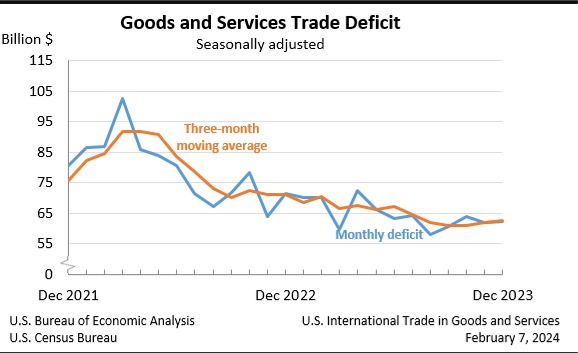
The above graph shows the good news. Our overall trade deficit, with other countries around the world has been going down in the three years of the Biden administration.

In fact, our trade deficit with China has also been going down. Everyday, if we tune into news, we hear bad news and it makes people nervous. The cost of manufacturing in many countries is less expensive. So, it is very much in the spirit of providing products at lower costs, that companies will outsource production.

Companies usually boast of how much of their goods are sold abroad. As I travel, it may seem odd, but the US presence can be seen in many countries. People want to stay in Marriott Hotels, be it in China or Saudi Arabia.

The US has a large trade deficit with China. In 2023, this deficit was 367 billion dollars. We have had a trade deficit with China for four decades. Much of what Trump says about the trade deficit with China is highly exaggerated. This is explained well in the link from Factcheck.org ,

Trump’s Latest False Claim About the U.S.-China Trade Deficit

From Factcheck, “The total U.S. trade deficit with China in goods and services in 2023 was about $252 billion, the lowest it has been in 14 years. Former President Donald Trump was way off when he falsely claimed that the U.S.-China trade gap is about four times as high.”

There are 3 great fallacy of Trump’s tariff plans. First is that we live in a global economy, and when fewer products are imported from China, then more are imported from other countries. During Trump’s time in office, our trade deficit increased.

Second, is that the importers will pass on the cost of tariffs in the form of higher prices to consumers in the US. So, the billions of dollars the government is receiving is absorbed by US consumers, so it makes products in the US more expensive.

The third fallacy, and it has been proven many times, is that imposing tariffs on China goods, will result in tariffs on exported US goods, so it is a lose-lose situation.

Per the link with Brookings Institute, “The ensuing trade war cost the U.S. economy nearly 300,000 jobs. The tariffs served as a regressive tax on imported goods that were primarily borne by American consumers.”

Brookings Link: How will Biden and Trump tackle trade with China?

The bottom line is trade wars, cost jobs, and act as a tax on consumers. Trump always exaggerates the problem and extremely simplify the solution. He is simply playing to his base and using animosity towards China to promote trade wars. I fear it will end badly, and you know it will be blamed somehow on Democrats.

Harris will take a more global approach to trade, and it is my expectation, is that tariffs will be reduced through negotiations with China. Additional tax incentives to US manufacturers will improve the trade imbalance.

By electing Kamala Harris, at a minimum, we get a president who will listen to economists, instead of Trump’s clashes with them. You will have a president that works with other world leaders, because fair trade is really an international issue.

Stay tuned,

Dave

Trump’s economic advisors

“It is a horrible deal, really horrible, but we’re going to fix that”

This is any particular quote from Trump but applicable to many accords – from NAFTA, the Trans-Pacific Partnership and to many bilateral accords, most recently his attack on he  South Korean Trade Agreement.   The same quote can be said of the Iran Nuclear deal and the Paris Accords on Climate Change Mitigation.   Everything is blamed on prior administrations, but most of the blame still goes to President Obama.

A minor case in point –  on January 12, 2018,  Trump cancelled a trip to the US embassy in London, citing Obama poor decision in moving the Embassy at a cost of 1.2 billion dollars.   It was decided upon by President Bush and not Obama.   Trump rarely lets facts get in his way.

Gary Cohen,  was the head of the National Economic Council,  and chief economic advisor to Trump.   He is generally accredited for Trump’s tax cut and jobs program, signed into law on December 22, 2017.   On March 6, 2018,  Gary Cohen resigned in March, just before the imposition of tariffs on aluminum and steel.  It was widely reported that he was against the tariffs.  Larry Kudlow has been appointed to this position.   Kudlow is a strong believer in  supply-side economics, which means that a cut in federal taxes, will stimulate the economy sufficiently to make up for the loss in tax revenue.  He been dead wrong a number of times, beginning with the opinion that tax increases would dampen the economy during the Clinton administration.  Just the reverse happened, and the economy boomed after this.

Kudlow was a strong advocate of George W. Bush’s substantial tax cuts, and argued that the tax cuts would lead to an economic boom of equal magnitude. After the implementation of the Bush tax cuts, Kudlow insisted year after year that the economy was in the middle of a “Bush boom”, and chastised other commentators for failing to realize it. Kudlow firmly denied that the United States would enter a recession in 2007, or that it was in the midst of a recession in early to mid-2008. In December 2007, he wrote: “The recession debate is over. It’s not gonna happen. Time to move on. At a bare minimum, we are looking at Goldilocks 2.0. (And that’s a minimum). The Bush boom is alive and well. It’s finishing up its sixth splendid year with many more years to come”. In a May 2008 column entitled “‘R’ is for ‘Right,'” Kudlow wrote: “President George W. Bush may turn out to be the top economic forecaster in the country”. By July 2008, Kudlow continued to deny that the economy was looking poor, insisting that “We are in a mental recession, not an actual recession.” Lehman Brothers collapsed in September 2008, creating a full-blown international banking crisis.

Larry Kudlow is well educated, articulate and  very straight forward.  He has been a regular commentator on MSNBC.  His comments is generally appreciated, as he is well informed.  However,  he has been frequently wrong on the basic moves of the economy, I believe because of his philosophical perspective of less government intervention.   This has been chronicled in a book entitled Superforecasting (2015).   The book explains how experts in various fields, do no better than amateurs.

Two key advisers right now, are Peter Navarro, Director of the National Trade Council  and Wilbur Ross,  Secretary of the Commerce Department.   In many administrations, these organizations and individuals might not receive much attention, as they engage in behind the scenes negotiations on trade and commerce.   However,  as fears of a trade war with China,  intensify and concerns of the impact on our economy is debated,  these two individuals are increasingly in the media, particularly in the business news reporting.

Peter Navarro is a very controversial figure at present.  Wikipedia labels him as a heterodox economist, with opinions  outside of the mainstream economistss.   He is also considered a protectionist and isolationist by Wikipedia.   According to the Guardian:

Navarro was a key architect of Trump’s “America First” policy of economic nationalism and a tireless critic of China’s economic policies – one of his books is decorated with a map of America being stabbed in the heart with a knife marked Made in China. Although he has agitated for aggressively protectionist trade policy since joining the Trump campaign in 2016, the tariffs are his first key victory. During the campaign, Navarro, the only economics PhD in the Trump team, described his role as merely a facilitator. “The president – he’s the man who leads,” he told the Wall Street Journal. “He says, ‘I want to do this. How do we do it?’ The way I help is figuring out how you might do it.”

Protectionism, or economic nationalism?  Perhaps the choice of words doesn’t matter; it is the outcomes in the long run that are important.   I’ve included links on Peter Navarro at the end of this blog.

Finally,  a key adviser to Donald Trump is  Wilbur Ross.   His view on trade, as per Wikipedia:

On the subject of foreign trade, Ross has said: “I am not anti-trade. I am pro-trade, but I’m pro-sensible trade. [Being anti-trade] is a disadvantage of the American worker and the American manufacturing community.” Ross has also said that the government “should provide access to our markets to those countries who play fair, play by the rules and give everybody a fair chance to compete. Those who do not should not get away with it – they should be punished.” Initially in favor of the Trans-Pacific Partnership, Ross has said that after examining the agreement, he found it was “not consistent with what was advertised.”[34]

In 2004, The Economist described Ross’s views as protectionist. Germany’s chancellor Angela Merkel has also voiced concerns during 2018 World Economic Forum in Davos over Ross and the Trump administration views as “not the proper answer”.  Ross, at the 2018 World Economic Forum, responded to concerns by noting that “There have always been trade wars. The difference now is U.S. troops are now coming to the ramparts.”

Wilbur Ross has appeared on a number of business news stations, including MSNBC, and I happen to like his straight forward answers to questions.  He always seems to be well prepared, informed and polite.   He chooses his words well.    However, he seems to underplay the affect of the proposed tariffs  might have on the stock market.

How the Trump trade wars will finally be resolved, is difficult to say.   Republican biased news stations say that in the end,   the hard position taken  by Trump will result in China yielding, particularly on intellectual property rights.  Other commentators see only an escalation of tariffs, as China would rather fight than be seen as having given in to the US.   Economic nationalism works on both continents, sometimes escalation is easier than compromise.  Certainly, the sell off in the stock market is based on the potential for a protracted battle.

As I publish this blog, the Dow is poised to drop around 500 points.

I have included a number of links on Cohen, Kudlow, Navarro and Ross.   All individuals  have extensive biographies available on the Internet.

Stay tuned,

Dave

Links:

Wikipedia:Wilbur Ross

Wikipedia:  Peter Navarro 

Peter Navarro, the economist shaping Trump’s economic thinking

Wikipedia:  Larry Kudlow

New York Times:  Larry Kudlow is the new favorite to replace Gary Cohen

Wikipedia:  Gary Cohen